
Antique Silver Guide on how to read Tiffany Silver Marks to know the year date made and other interesting details
Updated: Oct 5

The following is a guide on how to read Tiffany Silver Marks to know the year date made (how old your item is) and other interesting details.
In this Tiffany marks guide you will find out how to date your Tiffany silver piece as well as identify its designer or company president for when the item was manufactured. There is also a section that explains special exhibition marks and other uncommonly seen Tiffany hallmarks.
Dating Tiffany Silver Pieces:
You can date almost every Tiffany & Co. Piece by finding its pattern number and then matching it with its known date of issue. The following section will show you how:

Deciphering Tiffany Numbers Stamped on the back of pieces:
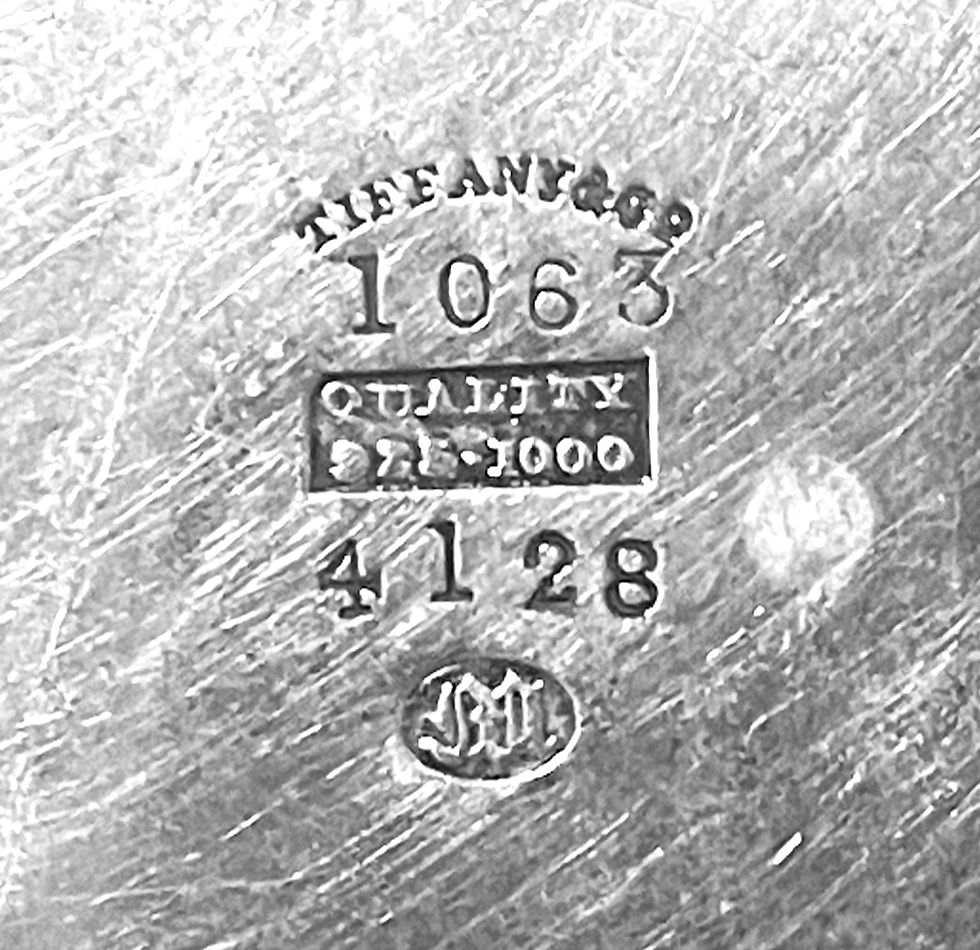
There are two sets of numbers that typically are stamped on the backside of most older Tiffany sterling silver hollowware pieces as well a limited number of flatware pieces:
The Pattern Number
The pattern number is always located on the left when there are 2 sets of number. This number is what is needed to determine the year date of the item. If there is only one number and not two sets of numbers, then the sole number stamped is the actual pattern number. You can disregard the Lot/Order/Stock # located on the right when trying to determine dates of the piece.
The Lot/Order/Stock Number
Is always located on the right when there is a pair of numbers. These numbers are internally used by Tiffany for lots, order or stock numbers and don't pertain directly to dating a piece of Tiffany. If you want to know more about a piece beyond its year date like hours it took to make or specifics about its craftsmanship, you will need this lot/order/stock number to determine that. Unfortunately, only The Tiffany & Co. Archive in New Jersey has that information and they only provide it to institutions, authors or people that are willing to pay a lot of money to have them retrieve that information from their archives.
How to determine the date of a Tiffany piece from the Pattern Number: Once you know the pattern number of the piece, you and easily cross reference this number to a known chart of date ranges (shown below) that are acknowledged to be when the pattern was made. Tiffany issued all of their pattern numbers in sequential order beginning from #1 (Year 1851) and going up all the way to the 20,000's (The 1950's.) These following charts (excerpted from the Book TIffany silver by Charles Carpenter) will show you the date ranges of when all Tiffany. & Co. Patterns were produced. Tiffany Sterling Silver Hollowware Items Showing Pattern Numbers Cross Referenced with Date Ranges: Note: These are approximations and you will need to make a judgment call on extrapolating the very exact date of an item.


Tiffany Sterling Silver Flatware Items Showing Pattern Numbers Cross Referenced with Date Ranges: Note: These are approximations and you will need to make a judgment call on extrapolating the very exact date of an item.

Examples: Here are a few examples on determining the dates of Tiffany Silver Pieces:


Only one number is present If there is only one number on a Tiffany & Co. Silver piece, then this is automatically the pattern number. Use this to find the corresponding date ranges to determine the age of your piece.


Tiffany & Co. Presidents Makers Marks
Tiffany stamped a letter on each piece of silver that represented the president of Tiffany for when the piece was manufactured.


These makers marks designate each president of Tiffany & Co. for the time frame they were active as the president. There is one exception in the president's lettering system which is the initial of an "M" for Edward C. Moore that was used from 1869- 1891. Edward C. Moore was never the president of Tiffany. He was Tiffany's genius designer and head of operations. Many collectors credit him for Tiffany's resounding success in cementing itself as the greatest silversmithing operation that ever was.
Edward C. Moore used his "M" as a makers mark on the pieces that were made during his administration. After Moore died in 1891, it was decided that instead of the designer's mark placed on a silver piece made by Tiffany & Co. that instead the current president of Tiffany & Co. would now have their last name initial placed on all silver pieces created to represent the company's makers mark.
The practice of stamping the pieces with these lettered makers marks was discontinued in the year 1965.

World's Fair and Exposition Marks
When worlds fair and international expositions were popular from the 1850's through the 1920's most silver makers and manufacturers from around the world would travel to these and set up large displays to showcase their products. We are not just talking about a trade show table or booth here. There would often be pop up stores that could be hundreds or even thousands of square feet in size and would display some of the very best products of the exhibiting manufacturer.
Tiffany & Co. was no exception and proudly displayed their finest pieces of silver at these world's fairs on a regular basis. In the year 1893 Tiffany & Co. decided to go one step further and created a special back stamp to commemorate the pieces that were shown at a particular exhibition. There are three known special stamps and here they are in the following chart.

If you see these additional marks or symbols on a piece of your Tiffany & Co. silver then that indicates the item was shown on display at the world's fair that the symbol represents. These "Tiffany Exhibition" pieces as they are referred to, are typcially some really ornate, oppulent or over the top items in high design and workmanship. The world's fairs held juried competitions on who had the best items on display and each manufacturer highly coveted these awards to add to their company's prestige. Regarding value, if you see a piece of Tiffany & Co. silver with the exhibition mark, it will almost always automatically double what the item would had been worth had it not had the extra stampings from the fair. There are many examples of this where the same exact awesome Tiffany & Co. silver piece was made in mutiples and the ones with the special trademarks sell for much higher than the same ones that were not marked specially. Can be the same exact piece with the only exception of one more back-stamp added on that makes it worth double up.


Comstock Lode Special Marks
Examples of Tiffany silver marked with the mine of the silver's origin are extremely rare. Only a handful of wares produced directly from the Comstock Lode are known to exist. Pieces that have these special marks tend to go for around 2-3 times more money than comparable items without the same markings.
The Gould & Curry silver mine was located in Virginia City, Nevada and was the second richest mine in the Comstock Lode. Alva Gould was a placer miner in California during the 1850s, and moved to Nevada in 1858 to prospect in the territory. He discovered silver on the grounds of the future mine on January 6, 1859 between the Best & Belcher and Savage mines, about two miles northeast of Virginia City. Abraham "Abe" Curry owned a nearby claim and soon joined Gould in partnership. Gould sold his interests shortly after the discovery to Curry, who in turn sold his shares of the mine to a twelve-party San Francisco cooperative which included George Hearst (1820-1891), successful California prospector and patriarch of the Hearst family.


Special Hand Work Markings on Tiffany Pieces
Although there are many Tiffany pieces that are produced with a hammered finish and have no other additional markings, there are a few that have been marked with "Special Hand Work." We are not sure if there was extra work done on these or not, but when you do see a piece with these marks, it is typically is a better design and quality and they go for more money in the antique resale market.


Tiffany & Co. Sterling Silver and Other Metals - Often referred to as Mixed Metal or Mixed Metals
In the late 1800's Tiffany & Co. along with a handful of other manufacturers like Gorham, Dominick & Haff, Whiting and George Shiebler experimented with the use of mixing different metals onto pieces of sterling silver. This was an influence from an influx of Japanese and Chinese cultures that had opened up in the 1850's and 1860's.
These pieces often have a sterling silver base or body and then applied elements (which were made separately) of gold, copper, bronze, niello or other metals are soldered onto the items.
When Tiffany made these mixed metal pieces they stamped the markings with "Sterling Silver and Other Metals." In today's market these are some of the most valuable pieces and highly sought after by antique silver collectors. They range in value from $350 to $3,000.00 per troy ounce.
Note: If the item appears to be mixed metal, but lacks the proper back-stamp, it's possible that the applique work was just plated and not actually full mixed metal. You'll usually see these unmarked items with only gold embellishments. Collectors tend to want to buy these pieces fully stamped and will likely shy away from pieces that lack the additional markings or that they are unsure of.


Tiffany & Co. Silver Plated Marks
Many people are unaware that Tiffany & Co. did produce a few pieces of silver plated items. These pieces only have a micro thin layer of about 30 microns of silver over copper. They are handsomely made as silver plated items go, and definitely could pass as real sterling silver to the untrained eye. Typically silver plated items made by Tiffany retail for between $25-$500 per piece. It doesn't sound like much, but compared to silver plated items from most other manufacturers (which are near worthless or worth very little), this is a top rate.
Tiffany Silver Plated Marks:
The following marks are what Tiffany designated for its silver plated items:
Silver Plate - This one reads how it is.
EP - This stands for Electro Plate which is silver plated
Silver Soldered - Silver soldered is more or less just a fancy way to say that the item is silver plated.

Tiffany & Co. Older Sterling and Coin Silver Marks
Tiffany silver pieces from the 1840's, 1850's and 1860's will typically not have the classic mark of Tiffany & Co. Sterling Silver.
The ones from the 1850's and 1860's will often say 925/1000 which is the numerical equivalent of sterling silver (92.5% silver.)
Older Tiffany silver items made of 90% pure coin silver from the 1840's and 1850's may only just say Tiffany & Co. and have no other markings. You will have to distinguish the items style to differentiate these pieces from silver plated. However, most Tiffany & Co. silver plated pieces are usually marked silver plate, silver soldered or EP.


Special Marks specific to the MET or Metropolitan Museum of Art
The MET and Tiffany & Co. had a special hand in hand relationship and upon occassion Tiffany & Co. would make items that pertained specifically to The Met. These items would includes special details within the markings.

Ephrain Brasher is considered to be the father of U.S. silver and gold coinage as well as being a gifted and revered silversmith in the early colonial era.
The MET had on display a piece or two of his silver works. In partnership with Tiffany. & Co, the museum had several reproduction bowls produced for them of his works to sell in The MET gift shop in 1917. These bowls were unusual for Tiffany & Co. in that they did an extended mark that included a full description of the piece. Most pieces ever made by Tiffany almost never have anything beyond the usual patttern numbers and other typical TIffany & Co. makers marks.
These bowls in today's market can be bought for around $100-$125 per troy ounce and they vary in weight from 600 grams to around 700 grams.


The Magnolia Vase was a special sterling silver commission piece that was donated to The MET by a very generous anonymous patron. Tiffany & Co. did a very elaborate raised up or applied inscription underneath the vase that gave all the details of its origins. This is definitely one of the most magnificent pieces of silver ever made on the planet and would likely be worth $10,000,000+ if ever sold.


Conclusion:
It would have been nice if Tiffany & Co. stamped the actual date made onto all their items as well as other pertinent information, but they at least fortunately had the code built into their pattern number system so that some one later on could actually accurately date these items. It might take some practice at first to get the hang of reading and interpreting Tiffany & Co. silver marks, but eventually you will become a pro and be able to determine the date made of almost any Tiffany & Co. silver piece ever created as well as ascertain some other interesting details. We hope our guide has helped you become proficient on interpreting the silver marks of Tiffany. Feel free to contact us if you have any questions or need any additional help beyond what our article was able to convey to you about Tiffany & Co. marks.

Please Sell Your Museum Quality Silver to The Silver Museum
We want to purchase all your antique sterling silver especially any pieces that have elaborate decorative work or that have any unusual themes. We are especially strong buyers of Tiffany & Co. silver and often are scouting out pieces and are willing to pay more to acquire these museum grade items to be able to add them into our own permanent collection. We can buy just single items, place settings, boxed sets, hollowware pieces and entire estate collections. We especially love buying from museums that are downsizing or from life long collectors who are looking to pass the torch and find a good home for their treasured collections.
Always fair and competitive quotes given.
We also buy common grade and scrap quality silver as well.
If you have items that you'd like to sell,
or even just want to get an idea on valuation
please click the email us button for a quote.
Please send us photos, measurements and item descriptions.
If it's a hollowware piece please include the item's weight as well.
Thanks,
Greg Arbutine
Silver Museum Owner


The Silver Museum buys all sterling flatware and hollowware regardless if it is rare or not.
We want it all!
Please sell your Sterling Silver Pieces to The Silver Museum!
Please get our offer no matter what else you eventually do.
We are always looking for great pieces for our Museum.


This guide offers incredibly precise details for dating Tiffany silver, which is invaluable for collectors. I found the explanation of how World's Fair and Exposition marks can double a piece's value particularly fascinating, highlighting the deep appreciation for historical context in collecting. It’s remarkable how such specific markings turn a beautiful object into a significant historical artifact, making the search for them as engaging as discovering new levels in unblocked games 66.