
W.K. Vanderslice Silversmith and Manufacturer in San Francisco, California in the 19th Century

W.K. Vanderslice Silversmith of San Francisco, California - In August of 2025, my family and I visited The Crocker Art Museum in California. To our delight, the museum had a nice display of silver made by WK Vanderslice of San Francisco, California. The pieces on display were very beautiful.

WK Vanderslice Entree and Sauce Tureens
Crocker Art Museum, gift of the Estate of Edwin Iloff, 2016.84.1-2
early 1860s
Silver
Crocker Art Museum, gift of Kay Yonemoto and Harold Wright, 2016.77.1
OBJECT: These entrée servers and tureen were used to serve sauces. The three-dimensional cast stag handles are typical design elements of Vanderslice silver, as are the beaded lid and Greek-key border.
ARTIST: Born in Philadelphia in 1823, William Keyser Vanderslice moved to San Francisco in the 1850s and partnered with his brother-in-law Charles Sherman. In the early 1870s, they opened a store on Sutter Street, selling flatware, hollowware, watches, jewelry, and diamonds. Vanderslice earned his first California accolades for a silver pitcher exhibited at the 1858 Mechanics' Institute in San Francisco.
LOOK FOR: A stag finial, a hallmark of Vanderslice.

History of W.K. Vanderslice - excerpted from The Encylopedia of American Silver Manufacturers by Dorothy T. Rainwater and Judy Redfield
W.K. VANDERSLICE
San Francisco, California
William Keyser Vanderslice learned silversmithing in Philadelphia and began business there in 1857. He arrived in San Francisco in May 1858 bringing with him equipment he had brought around Cape Horn. He set up shop in a building owned by his brother-in-law, Charles H. Sherman, a carpet and upholstery dealer. By September 1860 he had formed a partnership with Sherman, expanding his operation and moving to a new location with the increased capital. The partnership lasted until 1865.
Vanderslice established his reputation early through exhibitions. In 1858 he received a diploma for a pitcher shown at the Industrial Exhibition of the Mechanics Institute. In 1859 his work received a "First" premium at the California State Agricultural Fair. Although he did not compete again, by 1872 he was receiving large annual contracts to produce the Fairs' awards.
He also advertised heavily, as far away as Victoria, British Columbia, Canada.
The business grew. From a single employee in 1858, the shop expanded to employ 20 men and use 1,500 ounces of silver a month a decade later.
In 1868 Vanderslice went into partnership with Lucius Thompson, a jeweler and watch-maker, who previously had been a partner of George C. Shreve (q.v.) for a number of years. Thompson's experience as a retail jeweler and businessman blended well with Vanderslice's manufacturing knowledge. The new firm invested its money in dies and machinery and applied for its first flatware design patent. By 1871 Vanderslice was recognized as the leading firm in the region.
In 1872 the company moved its shop to the heart of the fashionable retail district. Although the firm obtained its second flatware design patent in 1874, it was also buying extensively from Gorham and Whiting.
The Depression of 1873 reached California in 1875. The destruction of Virginia City by fire that same year, taking two major mines out of operation, was followed by the collapse of production from the Comstock lode. Miners and speculators no longer had money to purchase luxury goods.
Vanderslice bought out his partner Thompson in 1878. He sold off much of his production at reduced prices and even auctioned some of his goods off, following a plan devised by the firm's financial officer, W.R. Drake, to get out of debt.
By January of 1881 the crisis had passed, but Vanderslice was no longer a major silver manufacturer. He took on a new partner, Kenneth Melrose, but retained only a token silver workforce. The firm gradually became more of a general jewelry and fancy goods retailing concern.
In 1893 Vandeslice had a leg amputated as a result of an accident. He suffered a stroke in 1895 and died in 1899.
The business was incorporated as W.K Vanderslice & Co. in March 1897 with Melrose as vice president. F ollowing Vanderslice's death in March 1899, Melrose became president. The business survived for a time, under various owners, as a fancy goods store, but succumbed to the great San Francisco earthquake of 1906. Only a token sum in insurance was recovered from the disaster. The business was sold to Shreve & Co in the year 1908.
The firm produced a large and varied range of goods in its heyday. Between 1858 and 1885, at least 16 flatware patterns were introduced. Holloware items from napkin rings to giant epergnes were of comparable quality to those manufactured by major eastern firms. Many of the pieces followed the "Renaissance revival" style of the times and were copied from works by companies like Gorham and Tiffany. Others were in a sort of Queen Anne revival style, and still others in a style unique to Vanderslice him-self. However the quality of the holloware designs declined after 1872, and seemed to be intended more to meet a price than an aesthetic ideal.
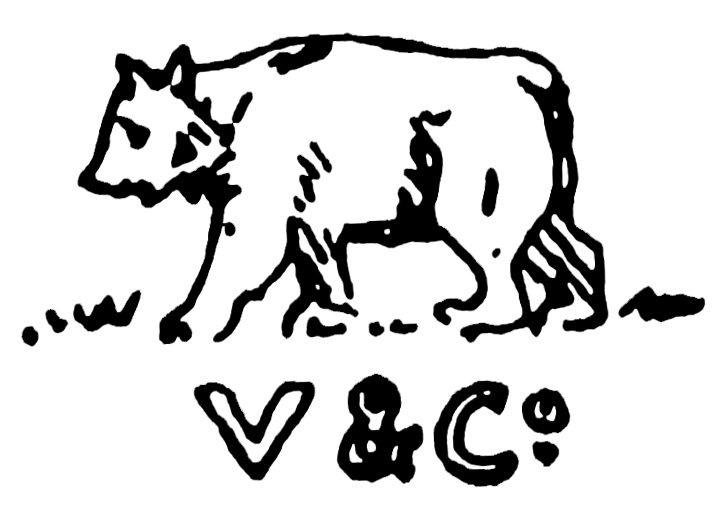
Conclusion: The W.K. Vanderslice Company produced some interesting and museum quality pieces. However, the company and owner suffered quite a few tragedies , personal health problems and external disasters. Had it not been for some really bad luck, the Vanderslice Company would perhaps have been around for a lot longer and would had established its brand as one of the more recognizable in today's market. Becauase of its lesser known status in comparision to Tiffany & Co., Shreve & Co., Gorham and other manufacturers, the silver of Vanderslice isn't in the top tier of antique silver collectors wish lists and many don't even know that the brand even exists - maybe they will now after our article about this company.
Please Sell Your Museum Quality Silver to The Silver Museum
We want to purchase all your antique sterling silver especially any pieces that have elaborate decorative work or that have any unusual themes. We love buying entire collections.
Always fair and competitive quotes given.
We also buy common grade and scrap quality silver as well.
If you have items that you'd like to sell,
or even just want to get an idea on valuation
please click the email us button for a quote.
Please send us photos, measurements and item descriptions.
Thanks,
Greg Arbutine
Silver Museum Owner


The Silver Museum buys all sterling flatware and hollowware regardless if it is rare or not. We want it all!
Please sell your Sterling Silver Pieces to The Silver Museum!
Please get our offer no matter what else you eventually do. We are always looking for great pieces for our Museum.


Comments