
George W. Shiebler & Co. a Brief Biography and Historical Account of this Gilded Age Famous Celebrity Silver Manufacturer, Silversmith and Designer
Updated: Feb 8

GEORGE W. SHIEBLER & CO.
George W. Shiebler & Co. was a major silver manufacturing company in Brooklyn, New York that operated from the year 1876 to 1910. The company had a shuffling of name variants from the year 1876 to 1891, but then incorporated and eventually settled permanently to become George W. Shiebler & Co. from the year 1891-1910 which is what it is still known as today. The various Shiebler companies during this time were led by its founder George W. Shiebler who was an expert designer and silversmith. The company created over 22 full line sterling silver flatware patterns and was also prolifict in producing match safes, napkin rings, fancy serving pieces, jewelry lines, spoon sets, bowls, hollowware items, statement pieces, presentation pieces, water pitchers, aesthetic themed items, mixed metal pieces, enamaled works, ancient style reproductions, nautical themed pieces, trophies, art nouveau silver, souvenir spoons and many many unique and novel art creations in sterling silver as well as 14 karat gold. The company was also a close rival at one time to Tiffany & Co.


The Early Years: George Washington Shiebler was born in 1846 in Baltimore Maryland, the son of a German immigrants: Andrew and Mary Shiebler. They had four children Andrew, William, George and Julia. George's two older brothers, Andrew K. and William, entered the jewelry & silverware trades also, and achieved notable success. George's father was a manufacturer of coach and military braid-one of the last in the business to abandon the hand-made article for the machine-made.
The family moved to Washington, D. C., where George went to school, and upon being graduated, he entered the employment of the Western Union Telegraph Company as a messenger boy. George served as a carrier of dispatches during the Civil War, and received many tributes for bravery from the War Department. He once carried an important message to General Warren on the field of battle, and in order to show his appreciation, the General autographed the despatch, and gave it to young Shiebler as a keepsake. This telegram was presented to the Warren Post of the G. A. R. at the dedication of the Warren statue in Prospect Park in Brooklyn.
After the Civil War, George W. Shiebler's first job in the metals trade was working as a travelling salesman for the gold chain manufacturing firm of Jahne, Smith & Co. in 1867. He remained with that company until the deaths of both Jahne and Smith in about the year 1870-71. George then became a partner in the successor firm of Hodenpyl, Tunison & Shiebler, which continued in the gold chain business. This firm, like many others, suffered financially as a result of the Panic of 1873. Shiebler withdrew from the business in 1874.
George married Hannah E. Moore Shiebler in around the year 1870. The couple had 3 children Arthur born in 1872, Edgar born in 1877 and Ralph born in the year 1888. Arthur was the only one the three children who eventually went into the metals business with his father George.
Upon the death of his father Andrew, George Shiebler took a temporary position at The Western Union offices again in Washington, D.C., under the supervision of Theodore N. Vail. In 1876. However, this was short lived and George gave up his position with the telegraph company and decided to give being a business owner a try.

Starting his own business:
George went into business for himself as a maker of gold chains. The firm was known as George W. Shiebler & Company. The concern moved to New York and founded a store at 8 Liberty Place in Manhattan. Shortly after this, the name of the firm was changed to The George W. Shiebler Company, which was to be a part of a silver consortion called "Silversmiths Company" — a proposed combination of the Gorham Company, Reed & Barton, Whiting. Dominick & Haff, and the George W. Shiebler Company. The George W. Shiebler Company's part in this combination was to do the breaking down and heavy rolling. The Silversmiths' Company was never completely organized for some reason or another and the corporation of the George
W. Shiebler Company was dissolved.
On March 4, 1876, with a force of five men, George began business again under his own name. The "and" was again admitted to the firm name, and George's oldest brother William F. Shiebler came into partnership with George W. Shiebler. Stores were opened on Maiden Lane in Manhattan near the financial district and also in lower Broadway. William F. Shiebler resigned shortly after this. Later on, George W. Shiebler's son, Arthur K. Shiebler, came in as partner to his father. The two remained together for the rest of the length of time while George W. Shiebler & Co. remained in business.
The Factory:
After starting in the small shop at 8 Liberty Place near Maiden Lane in Manhattan, New York. , George W. Shiebler soon moved his business over to the factory of Ketcham & McDougal in Brooklyn where he shared the facility with the other manufacturer. Here he stayed until his own magnificent factory at Underhill and 310 St. Marks avenue in Brooklyn, NY was completed.
We are not 100% sure if The Company identified itself as a NY, NY based company or a Brooklyn, New York Company. The factory was in Brooklyn and the retail stores and probably the corporate offices were in Manhattan. Most major auction houses that market George Shiebler silver items in today's age always identify them as originating from New York, New York. I suppose either city could be interpreted as being correct. One thing we are certain about is that George W. Shiebler himself was most definitely a Brooklynite as he had his church, mansion, community and factory all located there.

Expansion:
In the beginning, the Shiebler firm made only spoons and forks but its line was gradually expanded until it produced the largest line of novelties in silver extant at the time. Shiebler was a highly skilled and innovative designer and used his talents to enhance his firm's position. Over the years he obtained a number of patents for flatware patterns and souvenir spoons.
Over the next few years George acquired the tools and dies of a variety of important early firms. He purchased the business of Coles & Reynolds - manufacturers of silver spoons. He then bought out the business of John Polhamus in 1877. In 1883, he purchased the factory of Morgan Morgans, who had succeeded Albert Coles. This plant he merged with the others. In addition he also managed to obtain the flatware dies of A. & W. Wood (probably through Coles & Reynolds), Henry Hebbard, Hebbard & Polhamus, and Theodore Evans & Co. A few years later he moved the factory operations.
George Shiebler also forged strategic wholesale alliances with some other rival manufacturers and stores. Shiebler supplied companies like Tiffany & Co., Gorham, Howard and Company and a few others with his more specialized products that largely only his own factory was able to produce. These made for other company pieces will typically display the Shiebler trademark of an S in a circle flanked by two wings and then also have the other manufacturer's name and trademark as well. In today's antique silver marketplace, these co-branded hybrid pieces are generally attributed soley to George W. Shiebler and market values are derived based on that origin and brand accordingly.

On January 1, 1892 the firm was incorporated as George W. Shiebler & Shiebler & Co. which is how the Shiebler brand was there on known for the rest of its existence. George W. Shiebler was president and William F. Shicle its treasurer. George also became a director the New York Jewelers Association, as well as became a member of the Montak and Manufacturers clubs of Brooklyn. He was also a regular member of The Old Reformed Dutch Church on 7th Avenue in Brooklyn where he served as its musical director for several years.

Design Innovations and Product Highlights:
Geoge W. Shiebler is credited for the introduciton of several novel and innovative designs and metal working techniques in the silver making world. The following are examples of some of those:

Homeric Medallion Pattern Silver
George W. Shiebler was the originator of the curio medallion and "Homeric" style of jewelry, which was basically modeled after ancient Roman and Greek coins and sculptures (mostly those of Greek mythological origin.) The Homeric Medallion line of sterling silver first launched in the year 1882 with jewelry like brooches, sleeve buttons and bangles and after succeeding was then later extended to forks, spoons and hollowware.
These artful reproductions actually surpassed the ancient metal coins that they were originally inspired from because the newly designed pieces expanded beyond the confines of the limited roundness of the medallic coins. The new designs sprawled out into many shapes and sizes in both jewelry, silverware and hollowware and frequently used multiple medallion heads to create some really dramatic effects. Some of the items even employed the use of mixed metal fusing both silver and 14k gold in combination.
All of these pieces were inspired by characters from Greek and Roman mythology. The items were intentionally made to look like they were scarred from the ravages of time of antiquity depicting cracks, extreme age and ruggedness. When the pattern was first reviewed by magazine editors in the 19th century, it was commented that the pieces looked as though they had come from the excavations of Pompeii and Herculaneum. Others in the decades following would often refer to the pattern as the "Etruscan" style.
The Homeric Medallion pattern pieces were also mostly made by hand and each piece ever made is somewhat unique as the chasing and hammering varies from item to item. Although the bodies of the pieces as well as the medallion heads were all die struck from a plethora of dies that the firm had created and produced, almost no two items ever appears to be exactly alike. The artisans and chasers were clearly given a lot of latitude to embellish the items as they saw fit and didn't have to adhere to a set carbon copy design. They were, however, required to stay within the aesthetic of the ancient Greco-Roman design style.
These intentionally oxidized (blackened) silver items that were made to purposely to look like ancient pieces of antiquity were met with instant success. Prior attempts by other manufacturers to used blackened oxidization for non-Japanesque pieces of silver tp make the items look intentionally look old met with failure.
The Homeric Medallion pieces were made by using a secret special metals working solution and design process used to create these items. Jewelers and rival manufacturers all over the country and world tried to find the ingredients of the solution and duplicate the process, but almost all of them fell short or completely failed.

Homeric Medallion Necklace on Display at The Met NYC
This chain link silver-gilt necklace is composed of circular double links with a simple hook and eye closure. Fifteen circular pendant medallions, imitating ancient coins, are attached to the chain by single links. The medallions are graduated, each one featuring a unique classical head in profile, stamped in low relief. Though the profiles are finely delineated, the bodies of the medallions were finished with an irregular hammered surface.
During the later years of the 19th century a passion arose in both Europe and America for jewelry inspired by ancient coins, and this necklace is one example of the Shiebler firm's interpretation of that trend. An 1892 "Jewelers' Circular and Horological Review" article on the Shiebler firm described this "curio medallion work" as looking "as though it had been unearthed at Pompeii and Herculanaeum." The same article attests to the popularity of the line, stating that sales of what Shiebler described as his "Homeric Style" jewelry were "unprecedented perhaps in the history of the trade."

Homeric Medallion Fish Server and Knife at The Museum of Fine Arts, Houston
"Homeric" pattern George W. Shiebler & Co.
Date:
c. 1885
Place:
Brooklyn, New York, United States Medium:
Sterling silver and gilt
Dimensions:
.1:91/2 x 3 1/8 in. (24.1 x 8 cm)
2: 11 3/8 x 2 11/16 in. (28.9 × 6.8 cm)


Medallion Head Dies for Homeric Patttern
As of this writing, we have identified 25 different medallion head motiffs in the Homeric pattern made by George W. Shiebler & Co. The company clearly had the dies on hand and would use them to create the emblems in silver, gold and even bronze. There are 12 male and 13 female head designs of varying warriors, noblemen, generals, noblewomen and even a bust of Homer - which is where the pattern got its name from - look for the picture inscribed "HOMER" vertically up and down to the left of the head. So far we have matched 13 of the medallion heads all to figures of Greek Mythology. We are still in quest of identifying the remaning unkonwn 12 depictions.

Male Medallion Heads or Busts:
We have identified 12 unique male head motifs. We have pictured multiples of some of these heads.
Achilles Homer Homer

Female Medallion Heads or Busts:
We have identified 13 unique female head motifs.
.


Author Note: The pattern has been largely referred to as the Homeric Etruscan Medallion Pattern for many decades, however, so far in my research on this pattern, I've seen by far a more Greek influence with all of the more prominent medallion heads being Greek and all of the script and text inscribed on pieces also being in Greek. No doubt after a hundred years of the pattern being referred to often as the "Etruscan" style, that this label will likley continue to stick. However, it is this author and researcher's opinion that the "Homeric" pattern should be more aptly be referred to as the "Homeric Greek Medallion" pattern or just simply as the "Homeric Medallion" pattern and that the "Etruscan" portion of the name should be dropped, since there is little evidence of any Etruscan influence in the aesthetics of the designs, at least not enough to warrant that reference as an additional label.

Homer:
Homer - The inspiration of the Homeric Medallion Pattern - According to Wikipedia, Homer was an ancient Greek poet who lived in the 8th Century B.C. He was credited for writing The Iliad and The Odyssey - two epic poems that are the foundational works of ancient Greek literature. Read more about Homer on Wikipedia.

Dionysus:
Dionysus - Dionysus is the ancient Greek god of wine, revelry, theatre, and ecstasy, also known as Bacchus. Born to the mortal Semele and the god Zeus. He is the twice born god, because Zeus rescued him from his mother's womb and carried him to term in his thigh. He is a god of contrasts, embodying both civilization and barbarism, and his worship is associated with rituals, festivals, and the theatre. Source: Google AI

Helen of Troy:
Helen of Troy is the central figure in Greek mythology, known as the most beautiful woman in the world and the cause of the Trojan War. She is the daughter of Zeus and Leda, and her abduciton by Paris led to a decade-long siege of Troy by the Greeeks to retrieve her. Ultimately, Helen was reunited with her husband Menelaus, after the fall of Troy. Source: Google AI

Hermes:
Hermes was the Greek god of messengers, commerce, thieves, travelers, and athletes, known for his speed and cunning. He was the son of Zeus and Maia, and as one of the twelve Olympian gods, he served as the divine messenger, delivering messages between the gods and guiding souls to the underworld. His Roman counterpart was Mercury. Source: Google AI
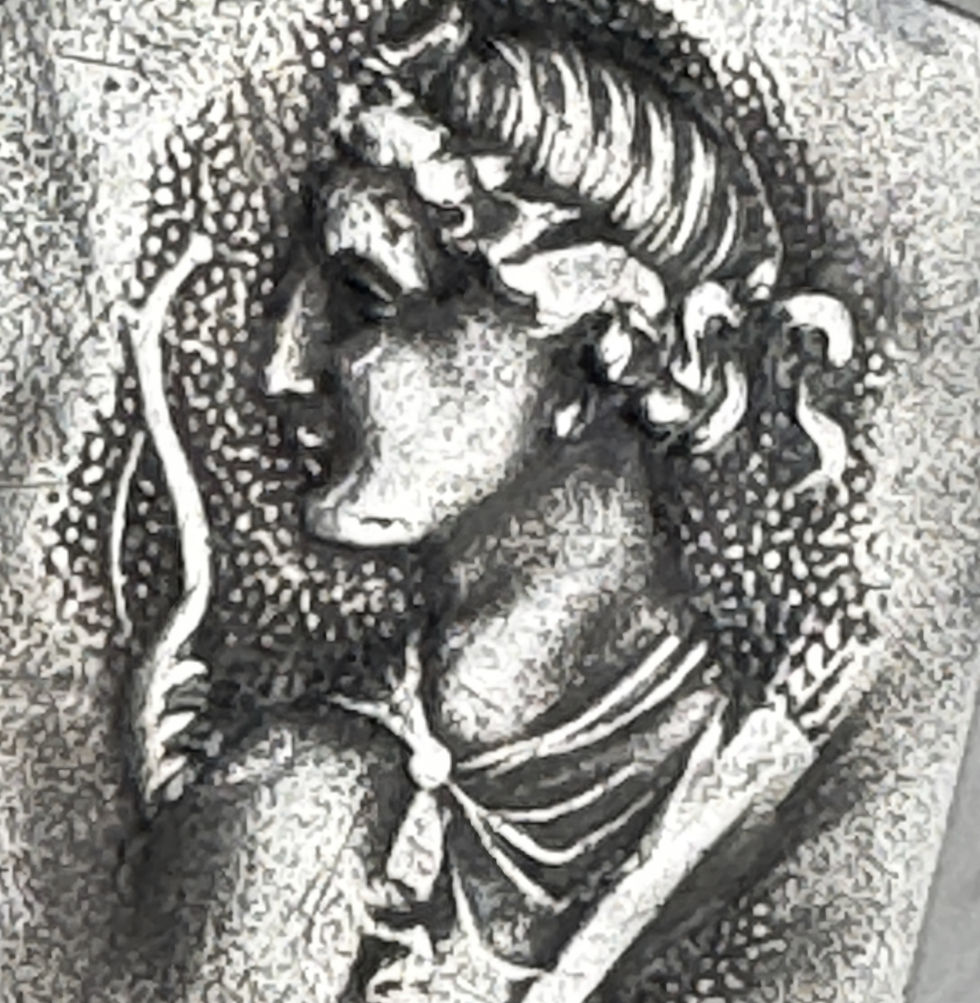
Artemis:
Artemis is the Greek goddess of the hunt, wilderness, wild animals, and chastity. She is the daughter of Zeus and Leto, and the twin sister of Apollo. Known for her eternal virginity and fierce independence, she is often depicted with her bow and arrow, surrounded by hunting dogs or nymphs. Source: Google AI

Athena:
Athena is the Greek goddess of wisdom, strategic warfare, and handicraft. She is the patron goddess of the city of Athens, which is named in her honor. Her symbols include the owl, olive tree, and snake. She famously sprang fully-formed from the head of Zeus, her father. Source: Google AI and Wikipedia

Bellerophon:
Bellerophon or Bellerophontes or Hipponous, was a divine Corinthian hero of Greek mythology, the son of Poseidon and Eurynome, and the foster son of Glaukos. He was "the greatest hero and slayer of monsters, alongside Cadmus and Perseus, before the days of Heracles." Source: Google AI and Wikipedia

Melpomene
In Greek religion, Melpomene is one of the nine Muses, patron of tragedy and lyre playing. In Greek art her attributes were the tragic mask and the club of Heracles. According to some traditions, the half-bird, half-woman Sirens were born from the union of Melpomene with the river god Achelous. Depictions of Melpomene may a tragic mask, buskins, lyres, scrolls, and a crown of leaves. She may also be shown with a dagger and a cup. Satirist Anthonly Pasquin described Melpomene as "murder-loving". Source: Google AI and Wikipedia

Pericles
Pericles was an influential Athenian statesman, general, and orator who led Athens during its "Golden Age" from around 461 to 429 BC. He is known for transforming Athens into the political and cultural center of the ancient world, overseeing the expansion of the Athenian Empire from the Delian League and sponsoring major building projects like the Parthenon on the Acropolis. A staunch supporter of democracy, his leadership also coincided with the start of the Peloponnesian War against Sparta, during which he died from a plague.
Source: Google AI and Wikipedia

Aphrodite
Aphrodite is the ancient Greek goddess of love, beauty, pleasure, and procreation, also associated with desire and lust. Identified with Venus by the Romans, she is one of the Twelve Olympians and has two prominent birth myths: one where she is born from the sea foam after Cronus castrates his father Uranus, and another where she is the daughter of Zeus and the titaness Dione. Her symbols include seashells, roses, and doves, and her worship centers were located on Cyprus, Cythera, and Corinth.
Source: Google AI and Wikipedia

Arethusa
In Greek mythology, Arethusa was a beautiful nymph pursued by the river god Alpheus. To escpae him, she was transformed by the goddess Artemis into a fresh water spring on the island of Ortygia in Syracuse, Sicily. However, Alpheus followered her by flowing under the sea and his waters mingled with hers, creating a sacred spring that can still be visited today.
Author Note: I had to do forensic science on matching up these medallion heads with their respective figures of antiquity. I think I have identified and matched them all correctly, however, if you have a difference of opinion I would be happy to listen - just email me. Also, would still love to find a George Shiebler & Co. catalog or magazine print ads that show the medallion heads with their official names as labeled and officially assigned by The George W. Shiebler & Co. My search is still on and and any help that can be provided to me would be greatly appreciated. Please Contact me at: Greg@silvermusuem.org

George W. Shiebler Sterling Silver Watch Fob
This amazing piece exhibits 11 different medallion heads in just in this one jewelry item. It is also one of the few pieces that
pictures the heads on both front sides and back sides of individual medallions. Most are blank on the reverse.
The Greek writing on the piece translates into English as "dora" the Greek word for "gift."

Pieces marked with "X" in the stock number - Not Homeric Pattern
What is the significance of George W. Shiebler silver items that are marked with an "X" at the end of the stock number? Our theory is that any item with an "X" in the stock number means that at although the item uses one or more of the Greek Medallion heads, it is not a member of the Homeric pattern. Instead, it is an experimental hybrid with more abstract, traditional or nouveau themes or styles. These pieces are worth a little less money than the Homeric items from what we have seen in the antique silver marketplace.

Competitors and Imitators of the Homeric Pattern
Only a few other American silversmiths like Frank Whiting, Howard & Company, Unger Brothers and Wood & Hughes even came close to reproducing similar quality items in this category as did some French and English jewelers. Makers in Birmingham, England called this the "Homeric style," a description that Shiebler used in his own advertising in year 1900.
The above sugar sifter is a good example of another company inspired to make its own version of the Homeric pattern. This piece is actually pretty good, especially with its intentional craggly hole at top and the pretty array of triangles and circles in the bowl. At least some of these rival companies were able to put their own creative stamp on the Homeric pattern and didn't just do complete knock offs.

This Athena Medallion Head Homeric sterling silver brooch made by Unger Brothers is another great example of a competitor to George W. Shiebler copying the Homeric style that Shiebler had introduced. This piece doesn't quite go all the way with any abstract cuts or unusual shapes to the piece. However, it is a finely made brooch and the attention to detail is amazing. It's also an original design and not just a blatant facsimile.
Precursors to The Homeric Pattern

There had been other medallion themed silver items made even decades prior to Shiebler's 1880's interpretation of the pattern by several other manufacturerers including Gorham, Wood & Hughes, Peter L. Krider, Knowles & Company, William Gale, Durgin and others. However, these earlier medallion renditions were more simplistic and the Greco- Roman style was confined only within inside the cameo or cartouche area of the overall silver item. The Shiebler Homeric style went all the way and decorated the entire item in The Greco-Roman style and didn't limit itself to be only an accent to a piece decorated in a completely different style.


Enameled Works
Some of the handsomest enameling work ever done in the United States came from the factory of George W. Shiebler. There were two special artists being employed for this work alone. Five designers and nine die sinkers created exclusive designs, and dies which made George W. Shiebler famous in every silver and jewelry house from coast to coast.

The Museum of Fine Arts, Houston
Enameled Bon Bon Server at
The Museum of Fine Arts, Houston
Sterling silver and plique-a-jour enamel
Date: 1891-1910
Place:
Brooklyn, New York, United
Dimensions:
Overall: 6 1/8 × 2 13/16 in. (15.6 × 7.1 cm)


Leaf Form:
Another one of George's innovations was his leaf form of silver which embodies a naturalist aesthetic form. He used this leaf form in bowls, jewelry, napkin rings, trays and serving pieces. Many of these pieces feature mixed metal elements as well as applied bugs or other insects or creatures of nature.


Leaf/ Berry Bowl
Design attributed to George W. Shiebler (American, 1846–1920)Produced by George W. Shiebler (1876–91)or produced by George W. Shiebler and Company (1892–1910) New York, New York
As one of many new manufacturers competing in a vast marketplace, George W. Shiebler began producing silver in the early 1870s. Although Shiebler’s firm was better known for its decorative flatware and silver jewelry, this bowl showcases the firm’s inventive design and dexterous handling of hollowware, which was made in more limited production. The intricate handle is formed of entwined branches and leaves, plums, and copper cherries, with three applied insects—a fly, a beetle, and a spider—further enhancing the object’s lifelike quality. While the vessel was inspired by Japanese naturalism, which was popular among American silver firms of the Aesthetic movement, the realistic details also reference John Ruskin’s belief that truth and beauty emerged from nature. Interestingly, the bowl is stamped with several French import marks, indicating that its American owner brought the bowl into France.

Gorgeous Leaf & Grapes Bowl
This Gorgeous Leaf Bowl by George Shiebler & Co. Sterling Silver is currently available for purchase on Ebay as of this writing. If you are looking to collect items made by George Shiebler definitely check out Ebay, Etsy, Heritage Auctions and Sotheby's to acquire some really awesome pieces of flatware, hollowware items and jewelry made by George W. Shieber & Co.

Filagree Open Work:
Shiebler is also credited with the introduction of the Renaissance open-work style in jewelry, bonbonnieres, tea strainers, bowls, dishes, trays and spoons. Some of these pieces had had dozens or even hundreds of hand piercings. It's likely that the items were meant to mimic the popular filagree style jewelry that was popular at that time.
These opulent and extremely ornate pieces were definitely meant to impress. In that time frame in the Gilded Age, anyone who could afford such finely made pieces were absolutely making a statement to their guests as to the status of their wealth.

Griffin Pierced Bon Bon Server -this is an extraordinary piece that had to have taken many man hours of work to hand pierce. According to Google AI - The griffin is a mythical creature with the body, tail, and hind legs of a lion, combined with the head, wings, and talons of an eagle. These legendary beings, which have roots in ancient Middle Eastern and Asian cultures, were often depicted as guardians of treasure and are symbolic of power and majesty.
Presentation Pieces:
Many famous pieces were made under the personal supervision of George W. Shiebler, among these being the golf trophy
awarded to Sir James Cox of England; a replica in sterling silver of the Santa Maria, Columbus' ship, for A. Stowell, of Boston, and the Col. Martin marksmen trophy for the 71st Regiment, Inf., V. G. N. Y. This last article cost $3,000 to produce.
It bore the equestrian figures of Generals Grant, Sherman and Sheridan-the former two reliefs being exact copies of a monument erected of Grant, and the St. Gaudens statue of Sherman at the 59th stret entrance to Central Park.
Elegant pastoral staffs for the bishops of Ohio and Tokio, the former displayed by Congdon & Company, were produced under the personal direction of George W. Shiebler George W. Shiebler always took pride in the fact that his company rolled and melted its own silver to the last. His metal was at all times assayed higher than sterling, and his products evidenced individuality more than anything else.

Yachting Trophy made by George W. Shiebler & Co. at The Brooklyn Museum
This trophy in the shape of a Spanish caravel (an early sailing ship) was presented by the Brooklyn Yacht Club to the winner of a regatta between New York and Marblehead, Massachusetts, in 1904 and follows in a long tradition of silver yachting trophies. It was made in the Brooklyn factory of George Shiebler & Company, and its design is based on a monument to Robert Louis Stevenson designed by Willis Polk in San Francisco. Made just after the turn of the century, the trophy looks backward to the elaborate revival designs of the 1800s rather than forward to the modernist works that surround it on the shelf.
Caption
George W. Shiebler & Co. (1876–1915); Willis Polk. Yachting Trophy, ca. 1904. Silver, 6 x 9 1/2 x 5 1/16 in. (15.3 x 24.1 x 12.8cm). Brooklyn Museum, Purchased with funds given by the Charles and Mildred Schnurmacher Foundation, Inc., 1998.91. (Photo: Brooklyn Museum

Loving Cup by George W. Shiebler & Co. at The Cincinnati Art Museum
Measurements:
including handles 9 1/2 x 10 in. (24.1 x 25.4 cm)
Gift of Phillip C. and Whitney Rowe Long
Date 1904
Success and the Fruits of his labor:
As a result of George's successful innovations in the silver industry along with his ability to network and gain notoriety, George became a very wealthy and famous man. He subsequently built a large mansion at Union st. and Prospect Park Plaza, one of the showplaces of Brooklyn. The mansion cost over $100,000, which at that time would have probably been $10,000,000 in today's dollars. The house had many attractive features and embodied many ideas for comfort and convenience devised by Mr. Shiebler himself.
Besides building up the great silverware manufacturing house, George W. Shiebler collected the
signatures of all the earth's celebrities and dignitaries, and when he died, owned the most famous autograph album in the world. It was valued at $100,000 in 1920 and was at that time in the possession of his grandson, Howard Shiebler. In the book are the names of every President and his wife since Grant; foreign statesmen, such as Nu Ting Fang, the Prince of Siam, Qucen Victoria, Edward VIl. etc. Sarah Bernhardt joked with Henry Ward Beecher on the last page of the album, and Mmc. Emma Calve passed a jest at the Divine Sarah. All of the famous musicians wrote little bars of music in the book; the authors contributed verses or bits of prose, and the artists made little sketches.
The autograph book is also a testament to how at that time on how George W. Shiebler was the silversmith to the elite and celebrities of his time. He clearly was able to have access to all of these people through their purchases of his silver articles, as well as his hob knobbing around in his broad networking to the rich and famous.

Gentleman Silversmith:
George W. Shiebler's travels at home and abroad made him a most interesting man, and an eminent newspaper man once said that in all his career of interviewing "big" people, it was his greatest pleasure, privilege and honor, to have met and known that tenderest, most loving, and most courteous of men, George W. Shiebler. He was the only gentleman in the strictest sense of the word, that the writer ever knew, or heard of, because in all his life he never caused another person a single moment of physical or mental distress.
Company Dissolved:
George W. Shiebler & Co. continued in business until 1910 when Shiebler dissolved the firm and retired as a manufacturer. George spent the last ten years of his life working for Gorham. The reasons are somewhat unknown as to why the company failed. It's possible that at age 64 George lost steam and wasn't the go getter he once was. He might have overpaid his staff or he didn't charge enough for his products. The reasons of the failure remain a mystery at this time.
The fate of most of the company's tools and dies is uncertain. Gorham reportedly purchased some of them. The Mauser Manufacturing Co. obtained the dies for the American Beauty flatware pattern. However, according to his obituary one of the greatest regrets in the last years of Mr. Shiebler's life was the fact that when, he failed in business that the buyers of his factory only took it under the stipulation that every spoon and fork die located therein was to be at once destroyed. The only reason ever designated for this was that the work was so massive that the metal used in each piece made the spoons and forks commercially unprofitable to handle. The destruction of these dies caused great sorrow among all true lovers of sterling silver table appointments. George's love for the beautiful forbade George W. Shiebler's making spoons of the thin light weight, so much in demand by the manufacturers today, who aim only to sell at great profit. Ironically, as a result in the long term, since no more would ever be made again, the values of the extant pieces have continued to go up in value as a result.

George's Death:
George W. Shiebler died on September 13th, 1920 at the age of 74 in Brooklyn, New York. He was given a Christian burial ceremony at The Old Reformed Church on 7th Avenue in Brooklyn, New York and then laid to rest at the Green Wood Cemetary in Greewood Heights, Kings County, New York, USA. There has been speculation that George died a poor man, however, considering the great personal weath he had accumulated as well as the fact that the family still owned the valuable autograph album, it's likely that George had been able to settle his business failure with out having to lose all his wealth and stature in the communites he was centered around.
Conclusion:
George Washington Shiebler was an amazing gentleman who contributed greatly to the world with his endeavors in design and creativity with his George W. Shiebler & Co. Silver Manufacturing Operations. His silver items to this day are still amongst the most prized and sought after by antique silver collectors and by museums all around the world. Many consider George W. Shiebler to be one of the greatest silversmiths and designers of silver to have ever lived.


Source Materials Used for this article:
Note: I had to amalgamate, sift through, sort out combine so many different accounts along with my own knowledge of George W. Shiebler''s historical happenings that I could not reference each bit of source material information line by line. Here are the major source materials to the article:
Historical Background and Text from Encyclopedia of American Silver Manufacturers 4th Edition by Dorothy T. Rainwater and Judy Redfield on Page 304 and Page 305 of the printed book or available at: https://www.antiquesilver.blog/post/encyclopedia-of-american-silver-manufacturers-a-book-in-print-by-dorothy-t-rainwater-and-judy-redfi
Picture contributions from Susan Shiebler on https://www.findagrave.com/memorial/57669622/george-w-shiebler
Newspaper Articles posted on Silver Salon Forums https://www.smpub.com/ubb/Forum13/HTML/000718.html
The Met in NYC - Necklace https://www.metmuseum.org/art/collection/search/20138
The Museum of Fine Arts Houston - Fish Server https://emuseum.mfah.org/objects/141506/fish-server-and-knife
The Museum of FIne Arts Houston - Bon Bon Server https://emuseum.mfah.org/objects/66988/bonbon-spoon
Chicago Art Institute Leaf Berry Bowl https://www.artic.edu/artworks/213882/berry-bowl
Brooklyn Museum Yachting Trophy https://www.brooklynmuseum.org/objects/2430
Cincinnati Art Museum Loving Cup https://www.cincinnatiartmuseum.org/art/explore-the-collection?id=11325576&title=Loving-Cup
John Hay Library in Providence, Rhode Island - George Shiebler Letterhead - courtesy of Nadine McAllister
The Silver Museum LLC - Photos of Punch Bowl, Etruscan Medallion Jewelry and several other photos
Gallery of Newspaper Articles used as Source Materials pertaining to George W. Shiebler

Article authored on 10-4-25 by Greg Arbutine
We are still looking for more source materials about George W. Shiebler as in:
catalogs, books, old photos, brochures, marketing materials, press releases and old print ads.
If we get enough reference material, we'll consider writing a print book.
We'd also love to obtain any parts, tool, dies or machinery from his factory to be used in a future museum exhibit.
Please email us if can help us with our continuing research.

Please Sell Your Antique Museum Quality Silver to The Silver Museum
We want to purchase all your antique sterling silver especially any pieces that have elaborate decorative work or that have any unusual themes. We love buying entire collections.
Always fair and competitive quotes given.
We also buy common grade and scrap quality silver as well.
If you have items that you'd like to sell,
or even just want to get an idea on valuation
please click the email us button for a quote.
Please send us photos, measurements and item descriptions.
Thanks,
Greg Arbutine
Silver Museum Owner


The Silver Museum buys all sterling flatware and hollowware regardless if it is rare or not. We want it all!
Please sell your Sterling Silver Pieces to The Silver Museum!
Please get our offer no matter what else you eventually do. We are always looking for great pieces for our Museum.


Bonus Material:
George W. Shiebler's Famous Brothers:
Andrew K. Shiebler:

William Shiebler:

George W. Shiebler Obituary


We are still looking for more source materials about George W. Shiebler & Co. Please contact if you can help us out. It would be greatly appreciated. Thanks for reading our article - Greg Arbutine


Teaspoons (From left to right: Achilles, Dionysus, Homer, Helen of Troy, Bellerophon)
τέλος


This is a great article! Been looking for this for years!